Over the last two weeks, we've looked at the water and electricity required to operate the enormous data centers being built for artificial intelligence. Both resources present real challenges, and billions of dollars are being spent trying to address them. This raises an obvious question: Why are we doing this in the first place? If AI were simply a better way to write an email or create a funny picture, building hundreds of billions of dollars' worth of infrastructure wouldn't make much sense. The bigger reason is that artificial intelligence is rapidly becoming an international economic and technological competition, and America's biggest competitor is China.
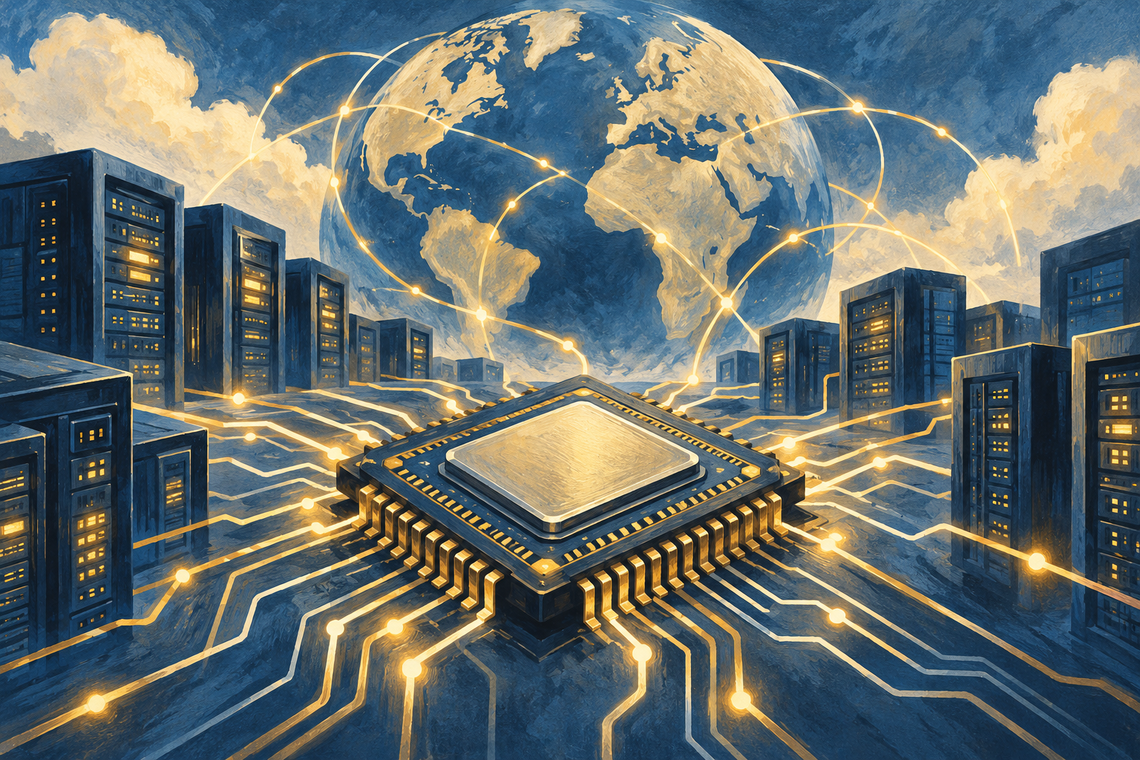
ThiS iS BiGGEr ThAn ChATGpT AI is increasingly being used in manufacturing, medicine, scientific research, cybersecurity, robotics, transportation, energy, and national defense. The country that develops the strongest AI capabilities may gain advantages across multiple industries at the same time. That requires more than good software. Advanced AI requires enormous computing capacity, specialized semiconductor chips, data centers to house those chips, and enough electricity to operate everything. The data centers we've been discussing aren't just giant buildings full of computers. They are part of a country's technological security and infrastructure.
ThE Chip wAr At the center of this competition are tiny pieces of silicon. Companies such as NVIDIA design incredibly powerful processors used to train and operate advanced AI systems. The United States has restricted China's access to some of the most advanced American AI chips and high-bandwidth memory, arguing that the technology also has military and national security applications. However, China isn't simply waiting around. Chinese companies are investing heavily in developing their own alternatives. Huawei has emerged as China's leading domestic competitor in advanced AI processors, while companies including Alibaba and others are developing chips and massive computing systems of their own. U.S. restrictions may have limited China's access to some cutting-edge technology, but they have also given China
a powerful incentive to reduce its dependence on American suppliers.
ChinA iS BUiLDinG Too One thing sometimes missing from America's data center debate is that choosing not to build infrastructure here doesn't mean it won't be built somewhere else by someone else. China is aggressively expanding its own computing capacity, electrical grid, semiconductor industry, and AI companies. At one point, China was approving roughly two new coal-fired power plants every week, and it continues to build coal generation even as it adds more wind and solar capacity than any other country on the planet. The larger point is that China understands something pretty fundamental: you cannot win a computing race without electricity. They're building AI chips, data centers, transmission, nuclear, coal, solar, wind, hydro, and batteries at an enormous scale. Chinese AI developers such as DeepSeek have already demonstrated that they can build highly capable systems despite restrictions on their access to the best American chips. This doesn't mean America should approve every proposed data center regardless of its impact. Water, electricity, land use, and costs to local communities still matter. But those decisions are taking place inside a much larger international technology race.
why CompUTinG CApACiTy mATTErS Think back to earlier technological races. Steel production mattered during industrialization. Oil
refining became strategically important during the automobile age. Semiconductor manufacturing became critical during the computer revolution. Computing capacity may become similarly important during the AI era. A country can have brilliant scientists and programmers, but without enough chips, electricity, and data centers, there's a limit to what they can build. That's why both the United States and China are spending so aggressively.
ThE BiGGEr piCTUrE None of this means we should ignore legitimate concerns about AI infrastructure. As we've discussed throughout this series, asking hard questions about water and electricity is exactly what communities should be doing. But there's another question worth asking: What happens if we don't keep up and China wins the race? There isn't a simple answer. It is becoming clear that the data center debate isn't only about how much water or electricity a building consumes. It's also about what role America wants to play in what may become one of the defining technologies of this century. Next week, we'll bring the discussion back home and look at the other side of the data center equation: what these enormous facilities can actually bring to the communities where they're built. Stay sharp, Eureka! Johnny is an insufferable Gen-Xer who escaped Southern California before the next Big One sinks it into the Pacific. He now calls Eureka home and refuses to leave. He can be reached for questions, comments, and ideas at [email protected]